
Measures attendance by location and time, with aggregated estimated age ranges and gender.

Business challenge
Many locations cannot accurately measure who visits, when peaks happen, or how footfall relates to sales, campaigns, and service capacity.
Product approach
HorusSense turns person detections into aggregated footfall, estimated age-range, and estimated-gender metrics without identifying individuals.
How it works
AI detects crossings or presence in authorized zones, prevents duplicates, and consolidates statistics by time, location, and segment with confidence indicators.
Why it matters
It supports staffing, opening hours, campaigns, and daily operations with comparable data and privacy safeguards.
Key benefits
- Entrance and exit counting
- Footfall by time window
- Aggregated estimated demographic segments
- Comparison across locations, periods, and campaigns
Target sectors
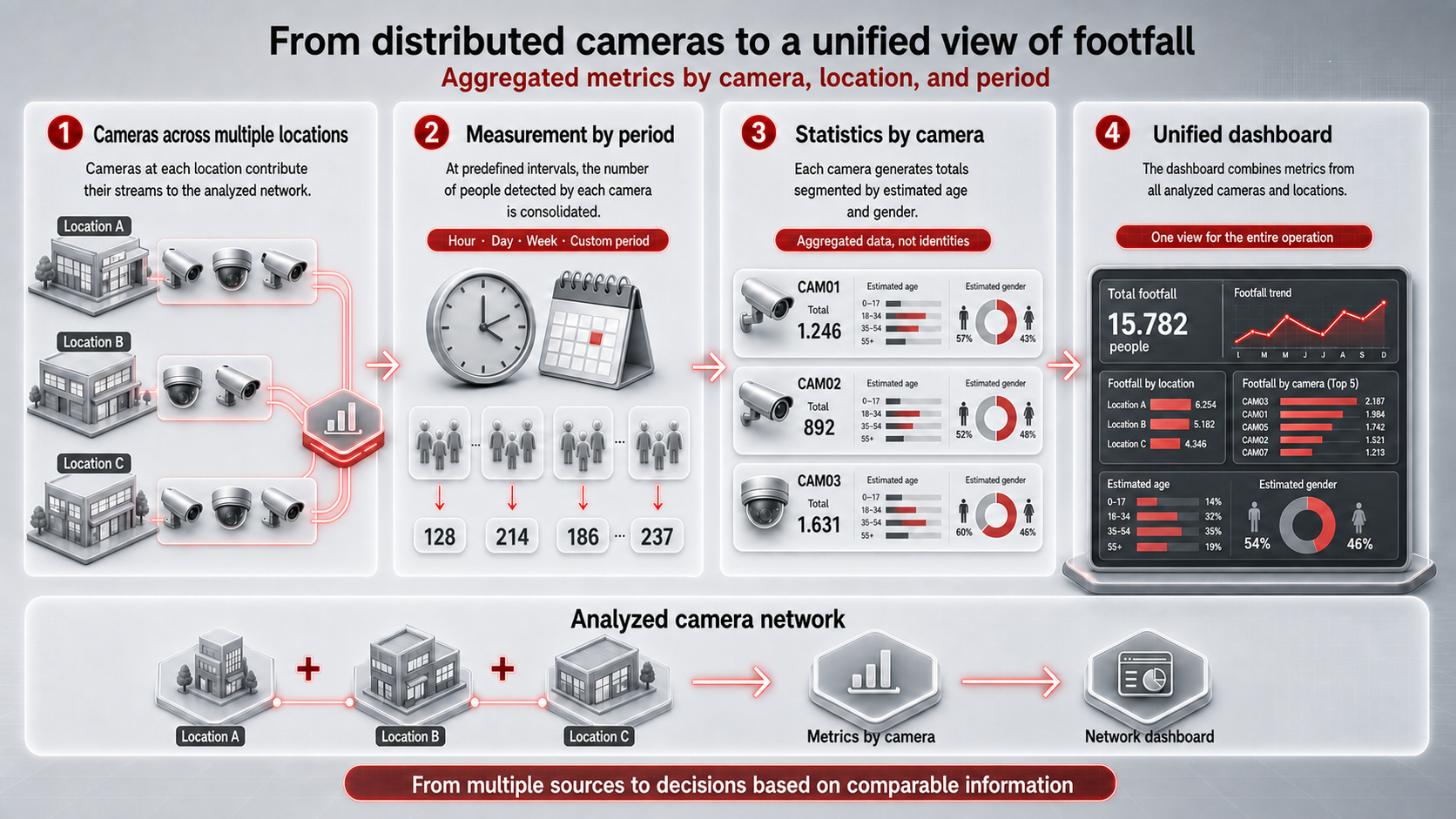
How it works
- An authorized camera detects a person entering or being present in a counting zone.
- The engine estimates an age range and apparent-gender category together with confidence levels.
- Ephemeral tracking prevents repeated counts during the same crossing.
- The detection becomes a statistical record tied to location and time without storing identity.
- Dashboards aggregate results by period and segment for comparison.
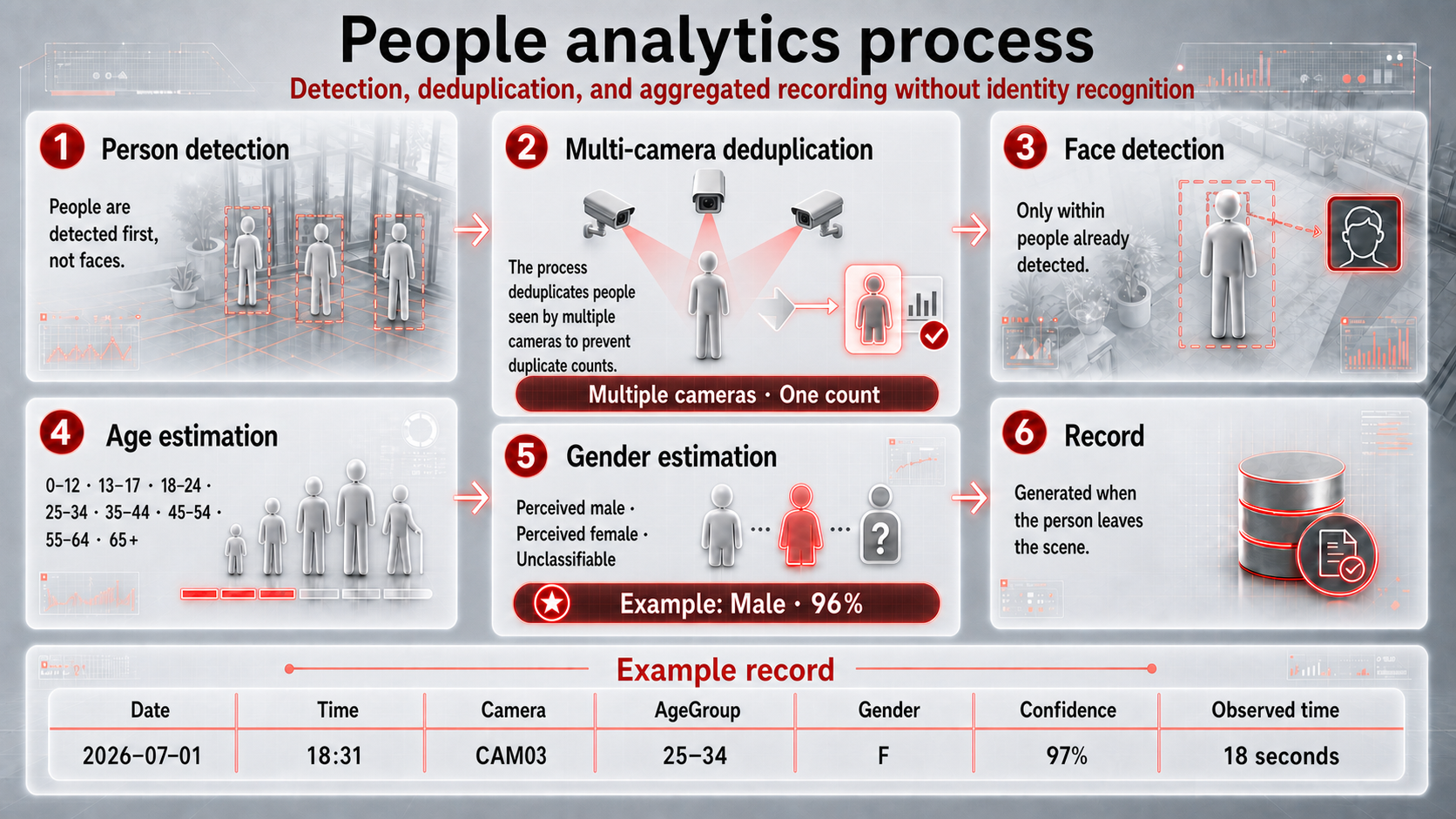
Specific capabilities
| Capability | Application |
|---|---|
| Footfall counting | Records entries, exits, or presence according to the configured zone and direction. |
| Age segmentation | Groups estimates into configurable ranges and includes undetermined results. |
| Estimated gender | Classifies apparent presentation as female, male, or undetermined; it does not represent declared identity. |
| Time-based metrics | Consolidates results by hour, day, week, custom period, and operating schedule. |
| Comparison | Contrasts locations, time windows, campaigns, and equivalent periods. |
| Confidence control | Sends inferences below the configured threshold to “undetermined.” |
| Aggregated export | Provides authorized metrics without images or biometric identifiers. |
Operational indicators
- Total people and average by time window.
- Busiest hours and days.
- Absolute and percentage distribution by estimated age range and gender.
- Aggregated intersections between time and audience segments.
- Change from a previous period or comparable campaign.
- Classifiable coverage, undetermined results, and average model confidence.
These indicators support staffing and opening-hour decisions, campaign evaluation, location comparison, and analysis of footfall against sales or service capacity.
Privacy and responsible use
Deployments must use appropriate notice and legal basis, limited retention, access control, and auditability. Small groups must be hidden or aggregated to prevent inference about specific people, and demographic classification must be switchable by location.